All published articles of this journal are available on ScienceDirect.

Preliminary Evaluation of Menstrual Blood as an Alternative Matrix for Multi-system Lipid Profile Measurement in Support of Self-testing Applications

Abstract
Introduction/ Background
A non-invasive, user-centered approach to lipid profile assessment was explored using menstrual blood as an alternative matrix to support the development of self-diagnostic devices. Conventional lipid measurements rely on peripheral venous blood, which limits accessibility due to invasive sampling, distance from healthcare facilities, and the laboratory's reliance on trained personnel. This study investigated whether menstrual blood could provide lipid profile measurements comparable to standard peripheral blood.
Materials and Methods
This study employs an analytical observational cross-sectional design. Menstrual blood samples from 25 women of reproductive age were conditioned with ammonium sulfate to a final saturation of 25% and centrifuged to obtain a clear filtrate suitable for analysis. Total Cholesterol (TC), triglycerides (TG), High-Density Lipoprotein (HDL), and Low-Density Lipoprotein (LDL) levels were quantified using three lipid measurement systems representing varying levels of technological complexity: intermittent analyzers, strip-based tests, and enzymatic colorimetric assays. Paired t-tests were performed on menstrual blood and peripheral blood as a reference.
Results
In peripheral blood and menstrual blood with intermittent analyzer, strip-based testing and enzymatic measurement techniques as follows: average (1) TG levels 270, 274, 274 mg/dL; and 256, 258, 262 mg/dL; (2) TC levels: 270, 274, 274 mg/dL; and 256, 258, 262 mg/dL. (3) HDL levels: 72, 95, 87 mg/dL; and 46, 71, 61 mg/dL. (4) LDL levels: 55, 38, 36 mg/dL; and 110, 71, 101 mg/dL. These three measurement techniques can detect lipid profiles from menstrual blood filtrate, but it is necessary to consider differences in data results from peripheral blood, as a correction factor. Thre was a strong correlation between menstrual blood and peripheral blood measurements (r = 0.68–0.93; p = 0.000).
Discussion
This study demonstrates that menstrual blood filtrate can be used to measure lipid profiles (TG, TC, HDL, and LDL) using various analytical systems, including intermittent analyzers, strip-based tests, and enzymatic assays; due to differences from peripheral blood data, correction factors must be applied. The use of menstrual blood can be recommended for self-testing of lipid profiles, with modifications to the detection instruments.
Conclusion
Menstrual blood can be used as a non-invasive alternative medium for measuring lipid profiles using intermittent analyzer systems, strip-based testing, and enzymatic methods.
1. INTRODUCTION
Lipid profiles, which include Total Cholesterol (TC), triglycerides (TG), High-Density Lipoprotein (HDL), and Low-Density Lipoprotein (LDL), are important parameters in assessing the risk of cardiovascular disease and metabolic disorders [1]. In women of reproductive age, hormonal fluctuations during the menstrual cycle are known to affect lipid metabolism, resulting in physiological and temporal variations in lipid levels [2]. Lipid profile testing currently generally uses peripheral venous blood obtained through venipuncture, that is, drawing blood by inserting a needle into a peripheral vein in the arm, to obtain a blood sample used for laboratory testing at healthcare facilities [3]. Lipid profile testing can also be performed using capillary blood obtained via a fingerstick [4]. This approach is invasive, requires trained healthcare personnel, and relies on laboratory facilities, making it less supportive of self-health monitoring and decentralized diagnostic services [5].
Advances in Point-of-Care Testing (POCT) technology, biosensors, and enzymatic colorimetric methods have enabled the development of portable, self-administered diagnostic systems [6]. These systems facilitate the measurement of metabolic biomarkers through simpler procedures, rapid analysis times, and minimal sample volume requirements, thereby potentially improving access to health screenings for populations with limited access to laboratory services [7]. These systems are also relevant for self-testing and point-of-care applications [8]. Therefore, the development of self-administered biomarker measurement methods compatible with point-of-care devices is becoming an increasingly relevant need. In addition to improving accessibility, self-monitoring of biomarkers has the potential to increase individual engagement in health management. Regular measurement of metabolic parameters allows individuals to evaluate physiological responses to changes in diet and lifestyle, thereby supporting a data-driven approach to preventive treatment and self-monitoring of health [9].
Menstrual blood is a biological fluid that is periodically present in women of reproductive age and can be collected independently without invasive procedures [10]. Menstrual blood consists of a mixture of peripheral blood, endometrial tissue, uterine secretions, proteins, lipids, and cellular components that reflect systemic physiological conditions [11]. Menstrual blood can be measured quantitatively and shows a correlation with biomarkers in peripheral blood, including metabolic and lipid parameters [12, 13]. These characteristics make menstrual blood a potential alternative biological matrix for the analysis of metabolic biomarkers [14].
Menstrual blood can be used for the analysis of molecular biomarkers, including proteins, metabolites, and lipids [15]. Lipidomic studies have shown that various classes of lipids can be consistently identified in menstrual blood and have potential as diagnostic biomarkers for both metabolic and reproductive conditions [16]. Recent lipidomic studies also indicate that various lipid profiles can be reliably detected in menstrual blood using dried blood spot formats, which are compatible with simple sample storage and transport from remote areas to analysis centers [17]. However, the use of menstrual blood as an alternative matrix for measuring lipid profiles, using commonly employed measurement systems, as a self-testing matrix, and in device design has not yet been evaluated.
These lipid parameters fluctuate in relation to the menstrual cycle and are influenced by hormonal changes, indicating that menstrual blood contains lipid-related components relevant to peripheral blood. Variations in TG, TC, LDL, and HDL throughout the menstrual cycle suggest that reproductive hormonal changes are closely linked to serum lipid composition. Variations in serum TC, TG, LDL, and HDL levels during different menstrual phases demonstrate a close relationship between hormonal changes and circulating lipid composition [18]. Menstrual blood has also been explored as a potential diagnostic biospecimen in lipidomic studies, further supporting its utility for lipid-related biomarker analysis [19].
Lipoprotein and triglyceride concentrations are reported to undergo systematic changes throughout the menstrual cycle. TC, LDL, and HDL concentrations vary systematically throughout the menstrual cycle, reinforcing the rationale for evaluating these analytes in menstrual blood specimens [20]. LDL and TC levels tend to increase during the luteal phase, while changes in HDL are associated with variations in estrogen and progesterone levels [21]. These findings strengthen the scientific basis for evaluating lipid parameters in menstrual blood specimens.
Advances in electrochemical biosensor technology and strip-based measurement systems have enabled the integration of sampling and biomarker analysis into a single compact device [22]. This technology is relevant for the development of self-testing devices based on menstrual blood that can be used for POCT [23].
Although menstrual blood has been identified as a non-invasive biological matrix that may reflect systemic metabolic status, the characterization of its analytical validity for measuring lipid profiles in portable diagnostic systems remains limited [24]. To date, there has been no adequate comparative evaluation of the analytical equivalence of lipid parameters, including total TG, TC, HDL, and LDL, between menstrual blood and peripheral venous blood when analyzed using platforms with different detection principles and technological complexities. The heterogeneous composition of menstrual blood, which includes cellular components, endometrial tissue proteins, and uterine fluid, has the potential to influence enzymatic reaction kinetics, optical absorbance characteristics, and transducer response in sensor-based systems. This variability may result in parameter-specific systematic bias depending on the architecture of the measurement system. Without a cross-platform validation approach and the development of matrix-based calibration models, measurement results cannot be considered clinically equivalent to peripheral venous blood reference values [25].
In addition, the heterogeneous composition of menstrual blood, which contains endometrial tissue, cervical mucus, tissue proteins, and cellular debris, has the potential to influence enzymatic reactions, optical absorbance characteristics, and sensor responses in biosensor-based diagnostic devices [26]. These factors must be taken into account in the development of menstrual blood-based measurement systems.
Therefore, this study aims to conduct an initial evaluation of menstrual blood as an alternative matrix for lipid profile measurement using several measurement systems with varying levels of technological complexity. This study is expected to serve as the basis for the development of self-testing and point-of-care diagnostic devices based on menstrual blood to support more accessible and non-invasive monitoring of metabolic health.
2. MATERIALS AND METHODS
2.1. Study Design
This study was conducted as a preliminary comparative investigation with an analytical observational design and cross-sectional studies. The primary objective was to compare lipid profile measurements obtained from menstrual blood as an alternative biological input matrix with those obtained from peripheral venous blood as the reference standard. In addition, the study evaluated the analytical compatibility of three lipid measurement techniques representing different levels of technological complexity: an intermittent analyzer, strip-based testing, and enzymatic colorimetry. The results of this study are lipid profile parameters, measured using an intermittent analyzer, strip-based testing, and enzymatic colorimetry. The exposure variable used for analysis was menstrual blood compared to venous blood (control). Sampling was performed using consecutive sampling among women of reproductive age, and potential confounding factors were not investigated. The rationale for a self-diagnostic tool for lipids using menstrual blood is its ability to measure lipid levels under various conditions.
2.2. Study Population and Sample Collection
Sampling was conducted from March to October 2023 in the Biochemistry Laboratory, Faculty of Medicine, Syarif Hidayatullah State Islamic University, Jakarta. A total of 25 women of reproductive age were voluntarily recruited. The participants who provided menstrual blood samples were between the ages of 18 and 55 years. Each participant donated both menstrual blood and peripheral blood specimens, allowing for within-subject comparisons and reducing inter-individual variability. Inclusion criteria comprised healthy women who were menstruating, willing to provide a venous blood sample collected by trained medical personnel and a menstrual blood sample collected independently on the same day (day 3 of the menstrual cycle). Participants were instructed to collect menstrual blood directly into sterile sample containers and to avoid contamination with urine. Individuals with a history of lipid-lowering medication use were excluded. The study protocol was approved by the Health Research Ethics Committee of the Faculty of Medicine, Islamic State University Syarif Hidayatullah Jakarta (Approval No. B-023/F12/KEPK/TL.00/04/2023).
2.3. Sample Processing
Peripheral venous blood samples were collected into EDTA-containing tubes and processed to obtain serum for lipid analysis. Menstrual blood samples were collected without anticoagulant, as clot formation does not occur in this matrix. Prior to analysis, menstrual blood samples were conditioned by the addition of solid ammonium sulfate to achieve a final saturation of 25%, followed by centrifugation/sedimentation to precipitate high-molecular-weight proteins. The resulting clear filtrate was used as the analytical input for lipid measurements. The lipid parameters analyzed included total TC, TG, HDL, and LDL. TC, TG, and HDL concentrations were measured using three analytical systems: (1) an intermittent analyzer (procedures from ISE Kits), representing a sensor-based point-of-care device requiring minimal sample volume; (2) strip-based testing (procedures from Lipid Pro), employing disposable enzymatic reagent strips with semi-quantitative readout; and (3) enzymatic colorimetry, using commercial enzymatic colorimetric assay kits (procedures from DiaSys) measured with a spectrophotometer and treated as the laboratory-based comparative method. All three parameters (TC, TG, and HDL) were measured in both venous serum and menstrual blood filtrate using the same three analytical systems to enable direct matrix-to-matrix and method-to-method comparison. LDL was not measured directly but calculated using the Friedewald equation:
The Friedewald calculation was applied to all venous blood and menstrual blood samples across the three measurement systems. Only samples with triglyceride concentrations below 400 mg/dL were included, in accordance with the established validity limits of the Friedewald method. This approach was selected due to its widespread clinical use and suitability for standardized comparison across different matrices and analytical systems [27].
2.4. Statistical Analysis
Paired statistical comparisons between venous blood and menstrual blood measurements were performed using paired t-tests, as the data were paired and met assumptions of normality and homogeneity. A p-value of less than 0.05 was considered statistically significant. All statistical analyses were conducted using IBM SPSS Statistics for Windows, version 26 (IBM Corp., Armonk, N.Y., USA).
3. RESULTS
Figure 1 summarizes the comparative lipid profile measurements obtained from menstrual blood and peripheral venous blood using three analytical methods: intermittent analyzer, strip-based testing, and enzymatic colorimetry. Overall, the results demonstrate that menstrual blood can be utilized as an alternative input matrix for lipid profile assessment, as all lipid parameters were successfully detected across the three measurement systems and exhibited trends comparable to those observed in peripheral blood.
The mean TG levels in peripheral blood measured using the intermittent analyzer, strip-based testing, and enzymatic colorimetry methods were 270, 274, and 274 mg/dL, respectively, while those in menstrual blood were 256, 258, and 262 mg/dL. TG levels in menstrual blood were slightly lower than those in peripheral blood across all analytical methods. Paired t-test analysis demonstrated a significant difference between menstrual blood and peripheral blood only in the intermittent analyzer method (p = 0.001), whereas no significant differences were observed in the strip-based testing (p = 0.856) and enzymatic colorimetry methods (p = 0.403) (Fig. 1). TG concentrations (Fig. 1) exhibited greater inter-method variability compared with TG, particularly in menstrual blood samples. Despite this variability, no statistically significant differences were observed between menstrual blood and peripheral blood measurements, and no extreme deviations were detected across the three analytical methods.
The mean TC levels in peripheral blood measured using the intermittent analyzer, strip-based testing, and enzymatic colorimetry methods were 270, 274, and 274 mg/dL, respectively, while those in menstrual blood were 256, 258, and 262 mg/dL. TC levels in menstrual blood were slightly lower than those in peripheral blood across all analytical methods. Paired t-test analysis showed no significant differences between menstrual blood and peripheral blood in the intermittent analyzer (p = 0.351), strip-based testing (p = 0.226), and enzymatic colorimetry methods (p = 0.461) (Fig. 2); concentrations measured in menstrual blood were consistently slightly lower than those in peripheral blood. However, paired t-test analysis indicated no statistically significant difference between the two matrices. All three analytical methods showed similar directional trends, indicating method-independent agreement between matrices for TC measurement.
The mean HDL levels in peripheral blood measured using the intermittent analyzer, strip-based testing, and enzymatic colorimetry methods were 72, 95, and 87 mg/dL, respectively, while those in menstrual blood were 46, 71, and 61 mg/dL. HDL levels in menstrual blood were consistently lower than those in peripheral blood across all analytical methods. Paired t-test analysis demonstrated significant differences between menstrual blood and peripheral blood in the intermittent analyzer (p = 0.000), strip-based testing (p = 0.000), and enzymatic colorimetry methods (p = 0.000) (Fig. 3) were markedly lower than those in peripheral blood and showed statistically significant differences across all measurement systems. This consistent pattern across analytical methods suggests that the observed differences are primarily attributable to intrinsic matrix characteristics rather than limitations of the measurement techniques.
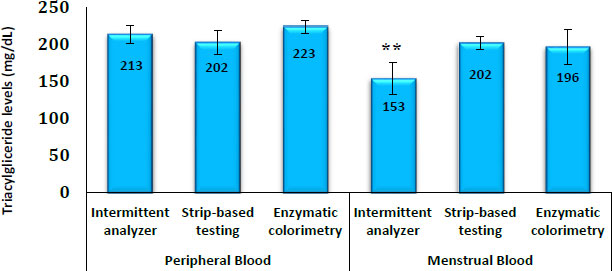
The comparison of TG levels between menstrual blood and peripheral blood controls (N=25), measured using three analytical methods: intermittent analyzer, strip-based testing, and enzymatic colorimetry. Data are presented as mean ± SD in the form of error bars. TG levels in menstrual blood were slightly lower than those in peripheral blood across all methods. The paired t-test showed a significant difference in triglyceride levels between menstrual blood and peripheral blood only in the intermittent analyzer method (**p = 0.001), while there were no significant differences in the strip-based test (p = 0.856) and enzymatic colorimetry (p = 0.403).

The Comparison of TC levels between menstrual blood and peripheral blood controls (N=25), measured using three analytical methods: intermittent analysis, strip-based testing, and enzymatic colorimetry. Data are presented as mean ± SD with error bars. TC levels in menstrual blood were slightly lower than those in peripheral blood across all methods. A paired t-test showed no significant difference in TC levels between menstrual blood and peripheral blood across all analytical methods: the intermittent analyzer (p = 0.351), the strip-based testing (p = 0.226), and enzymatic colorimetry (p = 0.461).

A comparison of HDL levels between menstrual blood and peripheral blood controls (N=25), measured using three analytical methods: intermittent analysis, strip-based testing, and enzymatic colorimetry. Data are presented as mean ± SD with error bars. HDL levels in menstrual blood were lower than those in peripheral blood across all methods. The paired-t test showed a significant difference in HDL levels between menstrual blood and peripheral blood across all analytical methods: the intermittent analyzer (**p = 0.000), the strip-based test (**p = 0.000), and enzymatic colorimetry (**p = 0.000).
The mean LDL levels in peripheral blood measured using the intermittent analyzer, strip-based testing, and enzymatic colorimetry methods were 55, 38, and 36 mg/dL, respectively, while those in menstrual blood were 110, 71, and 101 mg/dL. LDL levels in menstrual blood were consistently higher than those in peripheral blood across all analytical methods. Paired t-test analysis demonstrated significant differences between menstrual blood and peripheral blood in the intermittent analyzer (p = 0.000), strip-based testing (p = 0.000), and enzymatic colorimetry methods (p = 0.000) (Fig. 4). LDL concentrations were calculated using the Friedewald equation (Fig. 4), were relatively higher in menstrual blood than in peripheral blood, and differed significantly between matrices. This trend was consistent across all three analytical methods. The observed LDL differences reflect the combined influence of TC, TG, and HDL composition in the menstrual blood matrix rather than method-specific analytical effects.
Figure 5 presents an illustration of a prototype self-testing device concept for lipid profile measurement using menstrual blood as an alternative input matrix. Menstrual blood conditioned with ammonium sulfate to a final saturation of 25% and subjected to centrifugation results in a clear separation between precipitated protein and a transparent filtrate. The filtrate is suitable for the measurement of TC, TG, HDL, and LDL. Conceptually, the prototype integrates simplified sample preparation with a self-testing measurement unit, enabling lipid analysis without venous blood collection. The illustration further highlights the potential for integration with digital readout interfaces, supporting point-of-care and user-operated lipid monitoring. Quantitative variables for lipid profile parameters. Data distribution was assessed using the Shapiro–Wilk test. The variables were also plotted, and the mean and Standard Deviation (SD) were calculated and presented graphically. No threshold values (normal and abnormal) were established, as the focus was on determining alternative methods for measuring lipid profiles using three measurement techniques (intermittent analyzer, strip-based testing, and enzymatic colorimetry) and comparing them with peripheral blood as a control, followed by statistical analysis.
Quantitative differences between peripheral blood and menstrual blood measurements for all lipid parameters and analytical methods are summarized in Table 1. The data indicate systematic matrix-dependent differences for TC, TG, HDL, and LDL across intermittent analyzer, strip-based testing, and enzymatic colorimetry. These findings suggest that lipid concentrations measured from menstrual blood cannot be directly substituted for venous blood values without the application of matrix- and method-specific correction factors.

A comparison of LDL levels between menstrual blood and peripheral blood controls (N=25), measured using three analytical methods: intermittent analysis devices, strip-based tests, and enzymatic colorimetry. Data are presented as mean ± SD with error bars. LDL levels in menstrual blood were higher than those in peripheral blood across all methods. A paired t-test showed a significant difference in LDL levels between menstrual blood and peripheral blood across all analytical methods: the intermittent analyzer (**p = 0.000), the strip-based testing (p = 0.000), and enzymatic colorimetry (p = 0.000).

A scheme for using menstrual blood as an alternative sample for lipid profile testing. Menstrual blood collected on the third day of menstruation was processed using a 25% ammonium sulfate solution, followed by centrifugation or sedimentation to obtain the filtrate for analysis. The filtrate is then evaluated using three different analytical methods: intermittent analysis devices, strip-based tests, and enzymatic colorimetry. The lipid parameters measured include TC, HDL, LDL, and TG. This workflow demonstrates the potential for applying menstrual blood in self-testing and point-of-care lipid profile monitoring.
| Levels (mg/dL) | Difference between Peripheral Blood and Menstrual Blood | ||
|---|---|---|---|
| Intermittent Analyzer | Strip-based Testing | Enzymatic Colorimetry | |
| TC | 17 | 12 | 15 |
| TG | 59 | -14 | 20 |
| HDL | 28 | 26 | 28 |
| LDL | -59 | -34 | -68 |
Table 2 shows the average difference in results among three measurement techniques (intermittent analyzer, strip-based testing, and enzymatic methods) between menstrual blood and peripheral blood. Measurements of TC differences did not show significant differences across all measurement techniques, indicating acceptable agreement with reference standards. In contrast, measurements of the difference in HDL and LDL levels showed significant bias, characterized by overestimation of HDL and underestimation of LDL across all methods. Measurements of the difference in triglyceride levels showed method-dependent variability, with strip-based methods yielding results closest to control values. This study suggests that menstrual blood can serve as an alternative matrix for initial lipid profile screening; however, caution is required in interpreting HDL and LDL measurements due to the presence of bias.
Table 3 shows the analysis revealed a strong positive correlation between measurements obtained from menstrual blood and peripheral blood for all lipid parameters, with Pearson correlation coefficients ranging from 0.68 to 0.93 (p < 0.01). For TC in menstrual blood, all measurement techniques showed a very strong correlation (r = 0.90–0.93) with relatively small average differences (15–21 mg/dL) from peripheral blood data. Triglyceride measurements also showed a strong correlation (r = 0.85–0.88). Measurements using intermittent analyzers showed a substantial positive bias (mean difference of 59 mg/dL; 95% CI: 34 to 84), whereas strip-based methods showed minimal bias (-4 mg/dL; 95% CI: -18 to 10), which was close to the moderate control using the enzymatic method (20 mg/dL; 95% CI: 5 to 35).
| Parameters | Intermittent Analyzer Mean Diff (mg/dL) | p-value | Strip-Based Mean Diff (mg/dL) | p-value | Enzymatic Colorimetry Mean Diff (mg/dL) | p-value |
|---|---|---|---|---|---|---|
| TC | 17 | 0.000 | 21 | 0.000 | 15 | 0.000 |
| TG | 59 | 0.030 | -4 | 0.986 | 20 | 0.471 |
| HDL | 28 | 0.000 | 26 | 0.000 | 28 | 0.000 |
| LDL | -59 | 0.000 | -34 | 0.000 | -68 | 0.000 |
| Parameters | Method | Pearson r | p-value | 95% CI Mean Difference (mg/dL) | 95% CI of Mean Difference |
|---|---|---|---|---|---|
| TC | Intermittent analyzer | 0.92 | 0.000 | 17 | 8 to 26 |
| Strip-based testing | 0.90 | 0.000 | 21 | 10 to 32 | |
| Enzymatic colorimetry | 0.93 | 0.000 | 15 | 6 to 24 | |
| TG | Intermittent analyzer | 0.88 | 0.000 | 59 | 34 to 84 |
| Strip-based testing | 0.85 | 0.000 | -4 | -18 to 10 | |
| Enzymatic colorimetry | 0.87 | 0.000 | 20 | 5 to 35 | |
| HDL | Intermittent analyzer | 0.76 | 0.000 | 28 | 16 to 40 |
| Strip-based testing | 0.72 | 0.000 | 26 | 14 to 38 | |
| Enzymatic colorimetry | 0.79 | 0.000 | 28 | 15 to 41 | |
| LDL | Intermittent analyzer | 0.70 | 0.000 | -59 | -78 to -40 |
| Strip-based testing | 0.74 | 0.000 | -34 | -52 to -16 | |
| Enzymatic colorimetry | 0.68 | 0.000 | -68 | -90 to -46 |
For HDL, moderate correlations were observed (r = 0.72–0.79), but all methods showed a consistent and statistically significant positive bias, with mean differences ranging from 26 to 28 mg/dL. The confidence intervals did not cross zero. In contrast, LDL measurements showed the weakest correlation among the parameters (r = 0.68–0.74), although it was still statistically significant. All methods exhibited substantial negative bias, with mean differences ranging from -34 to -68 mg/dL and confidence intervals entirely below zero, indicating consistent underestimation.
Overall, despite strong correlations across all lipid parameters, bias is present, particularly for HDL and LDL measurements. TC showed the most acceptable results, whereas TG varied by method. Although menstrual blood can provide measurement results comparable to peripheral blood measurements, careful interpretation is still required, particularly for HDL and LDL, due to the consistent bias and potential limitations in the measurements.
4. DISCUSSION
A total of 25 participants were targeted and recruited for this preliminary study. All participants were screened for eligibility based on predefined inclusion and exclusion criteria, and all were confirmed to be eligible and included in the study. Complete biological samples (menstrual blood and peripheral blood) were successfully collected from all participants.
The present study demonstrates that lipid profile parameters can be measured using menstrual blood as an alternative biological matrix. Across all three analytical techniques, lipid profiles obtained from menstrual blood exhibited directional patterns comparable to those measured in peripheral venous blood for TC, TG, HDL, and LDL. TC and TG concentrations in menstrual blood tended to be lower than those in peripheral blood but did not differ significantly, whereas HDL concentrations were consistently lower and LDL concentrations higher in menstrual blood, with both parameters showing statistically significant differences. Taken together, these findings support the potential of menstrual blood as a non-invasive alternative matrix for lipid monitoring, while also highlighting matrix-dependent quantitative differences.
The observed differences between lipid concentrations in peripheral blood and menstrual blood can be explained by the biological characteristics of menstrual blood itself. Menstrual blood is a complex biological fluid composed not only of peripheral blood but also of endometrial tissue fragments, uterine fluid, immune cells, and secretions from the cervical and vaginal tract. This mixed composition has been reported in previous studies investigating hematological and biomarker profiles in menstrual blood [28, 29]. Despite these compositional differences, the consistent directional trends observed across matrices indicate that menstrual blood reflects systemic metabolic status, particularly with respect to lipid metabolism. From an analytical perspective, enzymatic colorimetry and strip-based testing generally yielded higher TC and TG values compared with the intermittent analyzer for both peripheral and menstrual blood samples. This observation is consistent with prior reports indicating that spectrophotometric enzymatic methods offer higher analytical sensitivity and precision due to controlled reaction conditions and stable optical detection [30, 31]. In contrast, sensor-based intermittent analyzers, which are commonly designed for portability and rapid testing, may exhibit lower absolute values due to sensor calibration variability and semi-quantitative measurement principles inherent to many point-of-care devices [32, 33].
For HDL, the relative stability of concentrations across matrices and methods aligns with literature indicating that HDL is less sensitive to matrix effects and biological variability compared with LDL or TG [34]. In contrast, LDL concentrations showed greater variability, particularly in menstrual blood samples. This variability can be attributed to the use of the Friedewald equation, which calculates LDL indirectly based on TC, TG, and HDL. As TG concentrations tend to be more variable in menstrual blood, small fluctuations can disproportionately influence calculated LDL values. Consequently, LDL values derived from menstrual blood are more suitable for trend monitoring rather than definitive clinical diagnosis [35].
Quantitative differences between peripheral blood and menstrual blood were observed for all lipid parameters and across all analytical methods (Table 1), indicating that menstrual blood measurements cannot be directly substituted for venous blood values without appropriate correction. This requirement reflects fundamental matrix differences, as menstrual blood contains cellular and extracellular components not present in circulating venous blood, which can alter analyte distribution and analytical response. Such matrix effects have been identified as a major challenge in validating menstrual blood as a diagnostic specimen [36].
Previous studies have reported significant correlations between biomarker concentrations measured in menstrual blood and those measured in systemic circulation, including lipid parameters, despite differences in absolute values [37]. Accordingly, menstrual blood appears capable of capturing the direction and relative magnitude of lipid changes, although numerical correction factors are required to align results with established venous blood reference ranges. This issue is further compounded by physiological variations in lipid levels across the menstrual cycle itself. TC and LDL concentrations in venous blood have been shown to vary by cycle phase, with higher levels during the follicular phase and fluctuations in HDL around ovulation [38]. These intrinsic variations underscore the importance of standardized sampling timing and matrix-specific calibration models.
The need for parameter-specific correction factors is evident from the magnitude of differences observed between peripheral and menstrual blood across analytical methods. For example, triglyceride levels measured in menstrual blood showed substantial offsets relative to venous blood, particularly when measured using the intermittent analyzer. These findings suggest that regression-based correction models or device-embedded calibration algorithms will be required to translate menstrual blood measurements into clinically interpretable values. Standardization of sampling, sample preparation, and analytical protocols is therefore essential to ensure reproducibility and comparability across devices and settings.
The prototype illustration presented in Fig. (2) reinforces the feasibility of using menstrual blood as a non-invasive diagnostic input for lipid self-testing. Emerging evidence from lipidomic studies has demonstrated that menstrual blood contains diagnostically relevant lipid signatures associated with specific physiological and pathological states, such as endometriosis [18]. Although the present study employed three relatively simple and widely available analytical methods, the successful detection of lipid parameters supports the concept that menstrual blood can serve as a practical input matrix for TC, TG, HDL, and LDL assessment in user-operated systems. This aligns with broader evidence that menstrual blood-derived biomarkers correlate with systemic physiological status and may support non-invasive screening and self-monitoring applications.
Nevertheless, several challenges remain. Biological variability in menstrual blood composition, including differences in cellular content and protein concentration, may affect lipid measurement accuracy and necessitate robust correction strategies. In addition, the current sample preparation approach, involving ammonium sulfate conditioning and centrifugation, introduces technical complexity that must be simplified or automated for practical self-testing applications. Alternative low-complexity approaches, such as gravity-based sedimentation or timed incubation to allow protein precipitation without centrifugation, warrant further investigation [39].
This study demonstrates that menstrual blood can be used as an alternative lipid profile measurement tool; however, the level of agreement varies across lipid parameters and measurement techniques. Overall, there was a strong and significant correlation across several measurement techniques between menstrual blood and peripheral blood measurements for all lipid parameters. This suggests that menstrual blood measurements can be used to assess lipid profile levels.
The agreement analysis revealed systematic bias. TC showed no statistically significant differences across methods in the first analysis, and the relatively small mean differences with narrow confidence intervals in the second table indicate acceptable agreement. Although there was a trend toward a mean difference of 15–21 mg/dL, this deviation could be corrected for tolerance in future standardization of measurement tools.
In contrast, TG measurements showed method-dependent variability. Although the correlation coefficient remained strong, the intermittent analysis tool showed substantial positive bias (mean difference of 59 mg/dL), consistent with the significant difference observed in Table 2. The strip-based method showed the closest agreement, with a minimal and nonsignificant bias (-4 mg/dL), suggesting that this parameter may be more suitable for estimating TG in menstrual blood.
HDL measurements showed a different pattern. Although a moderate correlation was observed (r = 0.72–0.79), all methods consistently showed significant positive bias, with mean differences ranging from 26 to 28 mg/dL. Menstrual blood may not accurately reflect true HDL levels.
Similarly, LDL measurements showed the weakest correlation (r = 0.68–0.74) and substantial negative bias across all methods, with mean differences ranging from -34 to -68 mg/dL. The consistently lower LDL estimates are likely influenced by the calculation method used (e.g., the Friedewald formula), which relies on triglyceride values and may be less reliable in non-standard biological matrices such as menstrual blood.
Overall, these findings highlight the important distinction between correlation and agreement. Although menstrual blood measurements correlate well with peripheral blood values, the presence of systematic bias (especially for HDL and LDL) needs to be considered in correction factors, analysis, and decision-making when developing lipid profile detection tools. The limitation of this study is that it uses a relatively small sample. Future studies with larger sample sizes and direct measurement techniques are recommended to validate these findings and to explore potential correction factors or strategies for standardizing measurement methods and tools. Furthermore, this study revolved around a single-time-point sample without considering hormonal changes across different days during menstruation (days 1-10), which may affect lipid profile measurements.
Menstruation is not sterile and may contain bacteria derived from the microbiota of the vagina and lower female reproductive tract. During menstruation, blood passes through the cervix and vagina, allowing menstrual blood to mix with normal vaginal microorganisms. Identified bacteria include Lactobacillus spp., Gardnerella, Prevotella, Atopobium, and Streptococcus, which are part of the normal vaginal microbial ecosystem and not indicators of infection. The composition of the vaginal microbiota changes dynamically throughout the menstrual cycle under hormonal influences, with Lactobacillus remaining the dominant genus in healthy women [40].
The reproductive tract microbiota varies during menstruation and can shift according to hormonal and health conditions [41]. The vaginal microbiota maintains homeostasis of the reproductive tract, and menstrual blood naturally carries microorganisms from this environment [42]. Despite the presence of bacteria, menstrual blood remains a valuable diagnostic biospecimen if appropriate collection and handling procedures are implemented to minimize contamination [43]. Suggestions for future research include correlating bacterial counts with lipid profile measurements in the same menstrual blood.
The findings presented in this study and illustrated in Fig. (5) support a shift toward more accessible, non-invasive lipid monitoring paradigms. By leveraging menstrual blood as an alternative diagnostic matrix, this approach aligns with ongoing research efforts exploring menstrual blood for health monitoring in women of reproductive age and contributes to the development of user-centered, decentralized diagnostic technologies.
CONCLUSION
This preliminary study demonstrates that menstrual blood is a viable alternative matrix for lipid profile assessment, showing strong correlations with peripheral blood measurements across all parameters (intermittent analyzer systems, strip-based testing, and enzymatic methods) and analytical methods. TC showed the best agreement with no significant differences, while TG exhibited method-dependent variability, with strip-based This preliminary study suggests that menstrual blood can serve as an alternative specimen for assessing lipid profiles, particularly for measuring TC, showing significant agreement with peripheral blood across all analytical methods. TG measurements showed varying levels of agreement depending on the method used, while HDL and LDL showed no significant differences. Overall, these findings support the potential feasibility of menstrual blood for specific lipid testing applications and provide a foundation for further validation studies as well as the development of non-invasive or self-testing approaches.
AUTHORS’ CONTRIBUTIONS
The authors confirm their contributions to the paper as follows: E.W. and R.A.F.H.: Contributed to drafting, collecting laboratory data, searching for articles, reviewing, and editing the manuscript and approved this article.
LIST OF ABBREVIATIONS
| TC | = Total Cholesterol |
| TG | = Triglycerides |
| HDL | = High-Density Lipoprotein |
| LDL | = Low-Density Lipoprotein |
| ISE | = Ion-Selective Electrode |
| EDTA | = Ethylenediaminetetraacetic Acid |
| SPSS | = Statistical Package for the Social Sciences |
| POCT | = Point-of-Care testing |
| p | = Probability value in statistical testing |
| rpm | = Centrifugation speed |
| g | = Relative centrifugal force |
| SD | = Standard deviation |
ETHICS APPROVAL AND CONSENT TO PARTICIPATE
The study protocol was approved by the health research ethics committee of the Faculty of Medicine, Islamic State University Syarif Hidayatullah Jakarta (approval no. B-023/f12/kepk/tl.00/04/2023).
HUMAN AND ANIMAL RIGHTS
The Helsinki Declaration was adhered to in the involvement of human subjects in this study.
CONSENT FOR PUBLICATION
Written informed consent was obtained from the volunteers or their guardians for this study.
AVAILABILITY OF DATA AND MATERIALS
All the data and supportive information is provided within the article.
ACKNOWLEDGEMENTS
Declared none.